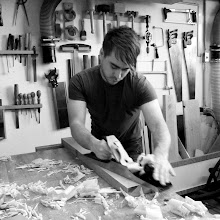
I've been mostly home sick this week, so decided to edit a little video about setting the blade of a wooden plane. Yes, this will explain the jump in posts over the next couple of days. The process isn’t overly complicated, but that’s not to say that it isn’t entirely simple. After a little practice, I can almost get the blade set without any test cuts. Anyway, the clip is after the jump.
Aside from the problem I have that tools seem to keep following me home, I have a problem with tools that try to do too much and don’t do anything well. You know what I am talking about, the tools that usually fit on a benchtop and claim to be the only tool you’ll need for every task. There’s usually some lasers or GPS involved.
However, I am pleased to say I have absolutely no issues with the most recent member of my tool foster-family, a small wooden smooth plane made by Don McConnell and Larry Williams of Old Street Tool.
I had been blowing glass for several years before I became vaguely aware of idea of coldworking glass. In the MIT Glass Lab there was old ~12”-14” flat lap at the off the shop which I’m fairly certain began it’s life as a battered potter's wheel. The grit in the tray underneath the lap was fill with some grade of “mystery grit” that was filled with bits of glass and whatever else fell in within the last year. I had used the wheel to flatten tippy pieces and make them less-tippy. To remove any amount of material took forever and, at best, the finish looked as if I had dragged the glass behind my car. One day, my friend Nick showed up with a little glass piece that he had cut in half with a diamond saw and had polished the cut surfaces. My mind was blown for two reasons:
1. You can cut things in half 2. You can make rough surfaces smooth and glassy again
This might seem like no big deal, but having never seen the process it all seemed like magic. Last night, I was in the Cold Shop preparing a blank for next weeks demo for my coldworking class and I thought it might be interesting to go through the process of flattening and polishing a relatively large piece of glass.
Before I get into the how to, I should mention a bit about the process shaping and polishing. Polishing is a progression of actions from course, medium, to fine. This relates to the size of abrasive grits that move from larger particle sizes to smaller particle size, but also the nature of process, more specifically, the inversely proportional relationship of speed and control.